“In Marosa di Giorgio’s excerpt from The Moth, the garden is explosive. Translated with a musical ear by Sarah María Medina, the prose poems luxuriate in their sheer volume of lush imagery, of ripe fruit and their rainbow palette, bacchanalian sweetness and insatiable appetite. Di Giorgio has always been an exceptionally visual writer, with her prodigious use of images inspiring comparison to the works of Bosch and Dalí—and here her painterly instincts are once again ravishing. In broad strokes a feast is spread before us, peaches and dates and syrup, as her image-language fills the lines with taste and spectacle. She once said that only the poet knows what colour to give each word . . . In The Moth, I paint myself as a reciter who interprets in front of the rosebush.”
Book Project
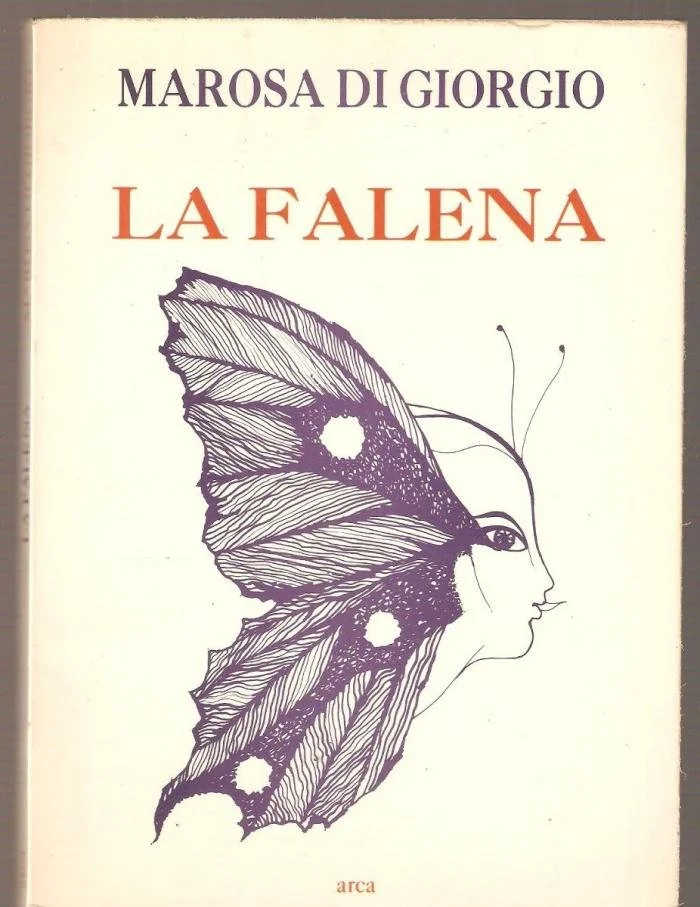
The Moth-Woman (La Falena), 1987
Uruguayan poet Marosa di Giorgio’s La Falena (The Moth‑Woman) was first published in 1987, two years after the civic‑military dictatorship ended in Uruguay. The collection’s poems work as allegories for personal and communal violence while also building an alternative historical narrative of survival. Within the landscape of ongoing violence, war, and genocide, di Giorgio uses surrealism as a strategy of resilience, critiquing political regimes while bearing witness to a world in constant transformation. In La Falena, a strange sweetness counters the monotony of violence, and persecution is often set within the natural world. After the violence, a black butterfly remains—present, but changed. The black moth (the bruja negra, or in Nahuatl mictlanpapalotl, “butterflies from the country of the dead”) becomes a figure of survival. Other poems turn to the surreal landscapes of di Giorgio’s childhood, where witness and uncertainty coexist: “I hear, yes, that ‘the children of the night make their own music;’ but I don’t participate in the feast. I am like a witness. Or I do participate, and I don’t know.” Across these scenes, the landscape is unpredictable, vibrant, alive.
Publications
“Excerpts from Marosa di Giorgio´s The Moth, translated by Sarah María Medina.” Poetry Magazine, March 2024.
“On Translating Marosa di Giorgio,” Poetry Magazine, February, 2024.
“Excerpts from Marosa di Giorgio´s The Moth, translated by Sarah María Medina.” Asymptote Journal, January 2023.
“Two Poetic Excerpts from Marosa di Giorgio, translated by Sarah María Medina.” Action Books: Poesía en Acción,April 2022.
Features
Asymptote Blog Editors’ Highlights: Winter 2023